
Generally, the formation of an NGO is inspired by the honest motive of working towards a social cause. However, in order to start your operations legally, there are some procedures and documentation involved. Having all your documents in place can save you a lot of trouble at the time of registering.
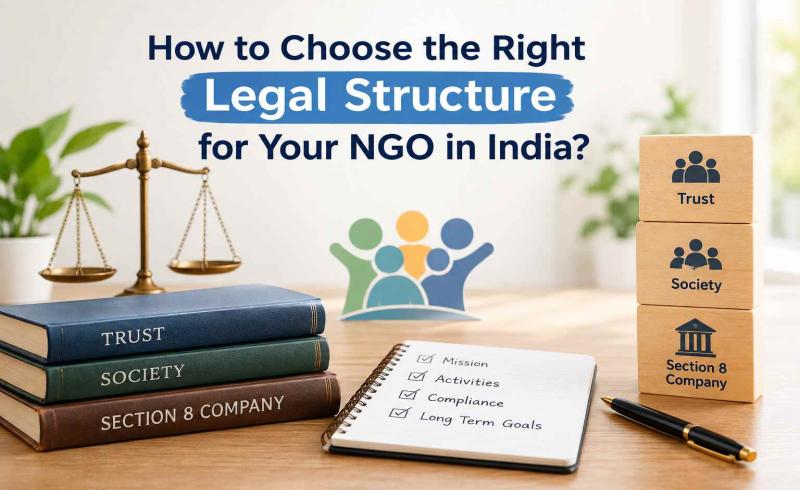
Registration of NGO can be done through different legal structures, mainly a Trust, Society, or Section 8 Company. Each structure has its own requirements. If you are planning to establish a Trust, you can also explore our Registration of Trust service to understand the process and documentation involved.
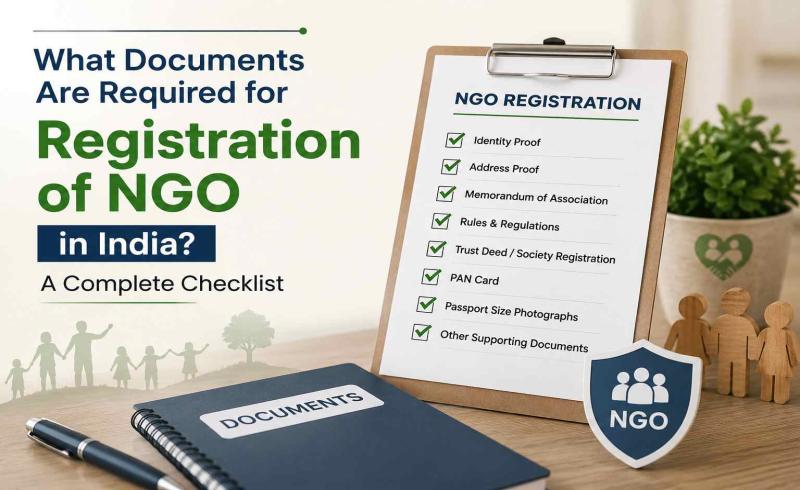
The exact documents depend on the type of organisation you choose. However, some documents are commonly required during the registration process.
These may include:
It is vital to ensure that there are no contradictions in names, addresses, and other particulars in all papers. The slightest inconsistency may cause some difficulties or corrections.
A Trust is commonly used for charitable and social activities. The main document required is the Trust Deed, which sets out the purpose of the Trust, details of the trustees, their responsibilities, and the rules for managing the organisation.
Other documents may include identity and address proof of the trustees, photographs, registered office proof, property documents, and an NOC from the property owner where required.
The Trust Deed should be drafted carefully because it forms the basis of how the Trust will operate in the future.
A Society generally requires a Memorandum of Association (MOA) along with its Rules and Regulations. These documents explain the purpose of the Society and how it will be managed.
The application may also require:
The exact requirements can vary depending on the applicable state rules, so the documents should be prepared accordingly.
The Section 8 Company is registered under the Companies Act, 2013 which gives a more structured format to eligible non-profit organizations.
The documents may include identity and address proofs of directors, PAN information, photographs, proof of the registered office, Memorandum of Association (MOA), Articles of Association (AOA), and other required declarations.
Additionally, Digital Signature Certificate (DSC) is required for the registration of the company and DIN (Director Identification Number) requirement is there for the proposed directors.
The registration is done by the Ministry of Corporate Affairs (MCA) and the concerned Registrar of Companies (ROC).
Documents are more than just a formality. They establish the identity, purpose, management, and registered address of the organisation.
Your governing document also explains what the NGO has been created to do and how it will be managed. These documents can later be required for opening a bank account, obtaining PAN, applying for tax-related registrations, dealing with donors, and completing other compliance requirements.
For anyone planning Registration of NGO in India, preparing the paperwork correctly from the beginning can save considerable time.
The first step is to decide which structure is appropriate for your organisation. A Trust, Society, and Section 8 Company have different procedures and compliance requirements, so this decision should not be made only on the basis of convenience.
Once the structure is finalised, decide on the organisation's name, objectives, founders or members, and registered office.
Next, collect the identity and address documents of everyone involved. Check the details carefully and make sure they match across the paperwork.
The governing document should then be prepared according to the selected structure. Once everything is ready, the application can be submitted to the relevant authority.
If you need help with NGO Registration, having the documents reviewed before submission can help prevent common mistakes.
Documentation errors are one of the easiest ways to delay the registration process.
Using an incomplete address, submitting an outdated utility bill, or having different spellings of names across documents can create problems. The objectives of the organisation should also be clearly written and should accurately reflect the activities it plans to undertake.
Another common mistake that people make is selecting a legal form just because a particular organisation has already adopted it. It must be determined by their goal, management system, etc.
For organisations setting up operations in Delhi NCR, such as Shahdara, East Delhi, Noida or Ghaziabad, it will be helpful for them to verify the relevant norms before finalising the application.
Getting the Certificate of Registration is an important milestone, but there may still be several formalities to complete.
The organisation may need to obtain PAN, open a dedicated bank account, maintain financial records, and complete applicable annual compliance and Income Tax Return (ITR) requirements.
Depending on its activities and eligibility, an NGO may also consider 12A Registration, 80G Registration, NGO Darpan, or FCRA Registration. GST requirements may also apply in certain situations.
Not every NGO needs all of these registrations. The requirements depend on the organisation's structure, activities, income, and funding.
It will be much easier if you understand the documents prior to that. It may help if you are not sure about how to structure your business legally and draft the necessary documents.
AABK & Associates assists individuals and organisations with understanding the documentation and registration process according to their requirements. The aim is to keep the process clear and practical rather than making it unnecessarily complicated.
If you are planning Registration of NGO in India, getting the paperwork checked before submission can help reduce avoidable corrections and delays.
Before submitting your application, make sure you have:
A final document check can save you from having to repeat parts of the process later.
The registration of an NGO becomes much easier when the legal structure and documents are planned properly from the start. Clear objectives, correct personal details, and proper registered office documents can prevent many common issues.
AABK & Associates can help with the documentation, registration procedure, and related compliance requirements. If you are planning to start an NGO in Delhi or Delhi NCR, you can also check our Google Business Profile for business information and client feedback before getting in touch.
For further assistance, Contact Us and discuss your requirements with our team. AABK & Associates is committed to making registration and compliance work easier to understand and manage.
Identity proofs, address proofs, documentation of registered offices, photographs, and documents related to the structure such as Trust Deed, MOA, or AOA are usually required.
It involves selecting the proper legal form, preparing the necessary documentation, filing the application with the relevant authorities, and getting it registered.
Yes, some registration procedures can be completed online, depending on the type of NGO and the applicable authority.
No. A Trust Deed is specifically required when the organisation is established as a Trust.
The timeline depends on the legal structure, documentation, government processing, and whether corrections are required.
The organisation may need a PAN, a bank account, proper records, and applicable registrations such as 12A, 80G, NGO Darpan, or FCRA.