
The food industry in India is one of the fastest-growing sectors, with thousands of new restaurants, cloud kitchens, catering businesses, bakeries, and food startups entering the market every year. While launching a food business involves several important steps, obtaining food license registration is among the most crucial legal requirements. It not only helps businesses operate legally but also ensures that food products meet the required safety and hygiene standards.
Whether you are a small food vendor, home-based food entrepreneur, restaurant owner, or food manufacturer, understanding the importance of food license registration can help you avoid legal complications and build customer trust. In this guide, we will explain what food license registration is, why it is mandatory, its benefits, and the documents required to obtain it.
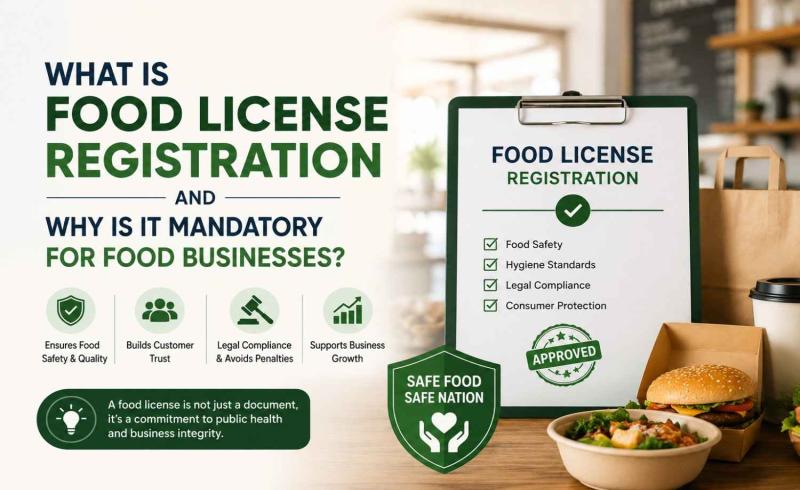
Food license registration is a mandatory authorization issued by the Food Safety and Standards Authority of India (FSSAI) to businesses involved in manufacturing, processing, packaging, storing, distributing, transporting, or selling food products. The purpose of food license registration is to ensure that food businesses follow food safety regulations and provide consumers with safe and hygienic food.
Every food business operator (FBO) is required to obtain the appropriate registration or license based on the nature, size, and annual turnover of the business. The registration serves as proof that the business complies with the food safety standards established by the government.
The main point of doing a food license registration is basically to help protect public health, so food stays safer and of better quality. Because food directly affects consumer health, strict regulations are necessary to prevent contamination, adulteration, and unsafe food practices. Businesses seeking Food license registration in Vishwas Nagar must comply with these standards to ensure legal compliance and consumer safety.
Here are some reasons why food license registration is mandatory:
Food businesses are required to keep decent hygiene, proper storage, processing, and handling routines, day to day. Food license registration basically makes sure the establishment sticks to the already set food safety guidelines, and it’s more than just paperwork.
Running a food business without food license registration can end up in penalties, fines, legal action, or even business closure, so it gets serious. Getting that registration helps a business stay on track with the relevant laws and rules.
Food safety rules are basically made to lower the odds of getting food illness, and to make sure that people actually receive safe as well as decent food products.
Through food license registration, authorities can monitor food businesses and take corrective actions when safety standards are not maintained.
Obtaining a food license registration offers several advantages beyond legal compliance. It helps businesses establish credibility and create a strong foundation for growth.
Consumers are more likely to purchase food products from businesses that hold a valid registration. Displaying your license number can improve customer confidence and trust.
A business with proper food license registration is viewed as reliable, professional, and committed to maintaining food safety standards.
A lot of distributors, retailers, e-commerce platforms, and corporate clients kinda prefer dealing with businesses that have valid registrations. It makes expansion easier and more efficient, like smoother. Honestly, it just tends to go faster when everything is on the up-and-up, registration-wise.
Getting a food license registration can help businesses dodge penalties and legal disputes, plus the other regulatory headaches that show up when they are not in compliance or when rules are simply not followed correctly. It’s one of those steps that makes things more stable and smoother, even if it feels a bit tedious at first.
Registered food businesses usually end up with better access to alliances, tenders, and a bunch of growth openings inside the food industry, so basically it helps.
Banks and other financial institutions can ask for some proof of registration when they are handling business loans or funding applications for food-related enterprises, just to be sure, in the usual way.
Most food-related businesses are required to obtain food license registration before commencing operations. These include:
If your business handles food at any stage of the supply chain, obtaining food license registration is generally necessary.
The exact documentation requirements may vary depending on the category of registration or license. However, some commonly required documents include:
Identity Proof
Address Proof
Business Documents
Photographs
Food Business Details
Additional Documents
Submitting accurate documentation helps ensure a smooth food license registration process.
The application process generally involves the following steps:
Ensuring accuracy in the application can significantly reduce delays and improve approval chances.
Running a food business without food license registration can have serious consequences. These may include:
Therefore, obtaining proper registration should be considered a priority for every food business owner.
Getting a food license registration can get pretty complex sometimes, especially if you’re new to the business world. AABK & Associates helps food businesses manage the whole registration set of needs—documentation support, application submission, compliance direction, and regulatory help. Their professional approach makes it easier for you to finish the process in a smoother way, and it also helps reduce delays plus errors that can pop up during filing.
Whether you are starting a new food venture or expanding an existing one, AABK & Associates can help you navigate the registration process with confidence.
Food license registration is not only a legal formality, but it is an essential thing that helps keep food safe and protects consumers. It also supports business credibility, so customers feel more confident. From building customer trust to meeting the relevant rules and regulations, there are real advantages that come with proper food license registration, regardless of whether a business is small or large. Once a food business gets the registration that is needed and keeps up with food safety norms, it can keep operating legally, make its reputation stronger, and set itself up for long-term success.